Fact or Fiction: Hay Analysis and Your Horse

Selecting a suitable forage is the foundation for every feed program, and hay analysis can be a vital part of both assessing forage suitability and balancing the diet accordingly.
Horse owners are becoming more and more aware of the benefits of forage analysis, leading to improved equine welfare and overall well-being.
With increasing awareness, increased horse-owner education is necessary to ensure dedicated equine caretakers are getting the most out of their hay analysis investment.
Join me, an independent equine nutrition consultant, to review frequently asked questions regarding hay testing.

Fact or Fiction: I can estimate nutrient contents based on cutting and appearance.
Fiction: A chemical analysis is the only way to know the true nutritional quality of your hay.
You CAN use visual appraisal to identify the species & maturity of the hay, which can help you predict some nutritional content such as calories, protein, and digestibility, but you will not be able to estimate mineral or sugar content visually.

Fact or Fiction: I NEED to have a hay analysis done in order to create a good diet for my horse.
Fiction: While hay analysis is always recommended, it is not always practical. In situations where hay changes frequently (i.e., you cannot store more than 3 months at a time), it may not be practical or feasible for the equine caretaker to be repeatedly testing hay. In such scenarios, it is recommended to explore alternative hay storage options to allow more consistency, as changes of forage can significantly increase risk of colic. Working with an equine nutrition professional can help you identify local mineral trends for best-matched recommendations when hay analysis is not practical or economically feasible.
Fact or Fiction: Only wet chemistry analysis is accurate.
Fiction: The current accepted techniques of hay analysis are wet chemistry and near infrared reflectance spectroscopy (NIRS). There has been recent concern re: chemical analysis procedures and their accuracy. Despite some horse owner concerns on use of NIRS, it can be an accurate method depending on the situation and procedures used (good quality NIRS will be calibrated using wet chemistry data). Harris et al (2018) compared wet chemistry and NIRS analysis and found good correlation for all paired subsamples.
Most quality equine forage packages use wet chemistry analysis for minerals and include equine-specific calculations.

Fact or Fiction: Hay sampling method matters.
Fact - If you're not sampling hay correctly, there's no point in paying the lab fee to have it analyzed (and more reputable labs will reject samples that are not quality samples).
"Sampling is the major factor affecting the accuracy of forage quality analyses".
- Fulgueira et al. (2007).
The correct way of collecting a hay sample is using a forage probe, which samples at least 20 cores of multiple bales. Any other method will not give you an accurate, representative sample, and is not recommended by evidence-based equine nutrition professionals.
A 2016 (Bodner et al., 2016) study comparing chemical analyses of samples collected via forage probe or hand-grab method reported that hand-grab samples resulted in values representing LOWER nutritional quality:
Affected 73% (11/15) of investigated parameters
Resulted in higher fiber contents
Lower values of macro- AND microminerals
The grab method will underestimate nutrient content of your hay, resulting in the interpretation that you need to supplement with more nutrients, which could increase risk of excessive intake and toxicities. A balanced diet that meets your horse’s requirements in a species-appropriate way is key.
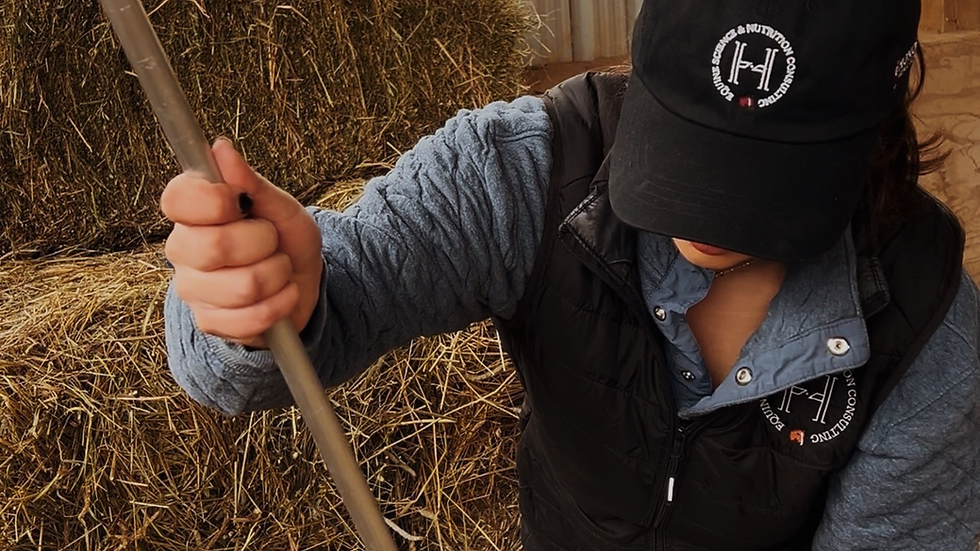
Sending a sample from 1 flake of hay is not representative of the whole hay lot due to bale differences, which is why a minimum of 20 cores is recommended when using a forage probe. Variation from sampling is 5-10x higher than variation in the lab (Fulgueira et al., 2007), so if you're investing in a hay analysis, make sure the sampling is done with a hay probe following proper sampling procedures (ie, collecting multiple samples, proper probe positioning, proper storage & transport to a reputable lab for analysis, etc).

Working with an NFTA-certified forage sampler and equine nutrition professional can help you follow the best practices for creating a strong, forage-focused diet for your equine best friend.

Isabelle D’Costa
Honos Nutrition Co.
Honos is home to independent equine nutrition consultant, Isabelle D’Costa. Based in Ontario, Canada, Honos Nutrition Co. offers on-farm and virtual equine nutrition support to horses and their humans all across North America.
With a Master’s degree in Equine Nutrition and a life-long passion for science communications, we believe in more than equine nutrition consulting: my services double as equine nutrition coaching that empowers YOU to make evidence-based decisions about your horse’s diet.
My horse is my best friend, and I know yours is too. You deserve to feel confident about what you're feeding them.
This article is from the December issue of Equine Business Magazine


Comments